

Credit Building and Repair: The Playbook for Turning a Score Into Funding Power
Credit building and repair is not a trick and it is not a secret product you buy. It is a sequence. First you learn what a credit score actually measures, then you clean up what is wrong, then you build a record that proves, month after month, that you pay what you owe on time. Do that long enough and the same record that helps you rent an apartment or finance a car starts to matter for your business too, because early on, most lenders look at the owner before they look at the company.
WHAT A CREDIT SCORE ACTUALLY IS
The Consumer Financial Protection Bureau, the CFPB, defines a credit score as a prediction of your credit behavior, such as how likely you are to pay a loan back on time. It is built from the information in your credit reports, and that is an important distinction. Your report is the record. Your score is a number calculated from that record.
You do not have one single score. You have a report at each of the three nationwide bureaus, Equifax, Experian, and TransUnion, and lenders do not all report to all three, so the reports can differ. On top of that, there is more than one scoring model. FICO Scores and VantageScore are the two main families, each with multiple versions, and most scores fall in the 300 to 850 range. A mortgage lender, a card issuer, and an auto lender may not pull the same version, which is why the number you see in an app may not be the exact number a lender sees. That is normal. The habits that move the score are the same either way.
Your income, your job title, and your savings balance are not part of a FICO Score. What counts is what is in the report.
THE FIVE FACTORS
FICO publishes how its scores weigh five categories for the general population. The exact weight can vary from person to person, but this is the map, and it tells you where to spend your energy.
- Payment history, 35 percent. Whether you paid past credit accounts on time. This is the biggest factor by a wide margin. Late payments, collections, and other negative marks live here.
- Amounts owed, 30 percent. How much you owe, and especially how much of your available credit you are using. That second part is called utilization. If you have a card with a $1,000 limit and a $500 balance, you are using 50 percent of that limit, even though $500 does not sound like a lot of money. The CFPB notes that many experts recommend using less than 30 percent of your total credit limit, and that people with the highest scores often use less than 10 percent.
- Length of credit history, 15 percent. How long your accounts have been open, including the age of your oldest account and the average age across accounts. Time helps, and closing an old card can shorten that history, so think before you close the oldest one.
- New credit, 10 percent. Recent applications and recently opened accounts. Checking your own report does not hurt your score. Applying for a lot of new credit in a short window can, because it can look like risk is building.
- Credit mix, 10 percent. The types of credit you handle, such as credit cards, an auto loan, a student loan, or a mortgage. You do not need one of everything. Mix tends to build naturally over time when the first two factors are handled well.
Put together, payment history and amounts owed are 65 percent of the score. If time is limited, start there.
WHAT DRAGS A SCORE DOWN
Most score damage comes from a short, familiar list. Payments reported 30 days late or more, and the later the payment, the heavier the hit tends to be. Balances that sit close to the limit month after month. Accounts that go to collections. A foreclosure or a bankruptcy. And errors that were never yours in the first place, such as an account you do not recognize, a payment marked late that was paid on time, or someone else’s information mixed into your file.
Two honest timeframes belong here, because repair talk often skips them. The FTC notes that accurate negative information can generally stay on a report for seven years, and bankruptcy information can stay for ten years. Its impact fades as it gets older and as newer, on-time history builds on top of it, but nobody can legally erase accurate negative information early, and the CFPB is plain about this: rebuilding credit takes time and there are no shortcuts. Any service that promises a fast, guaranteed score jump or the removal of accurate negative information is selling something the law does not let it deliver.
THE REPAIR SEQUENCE
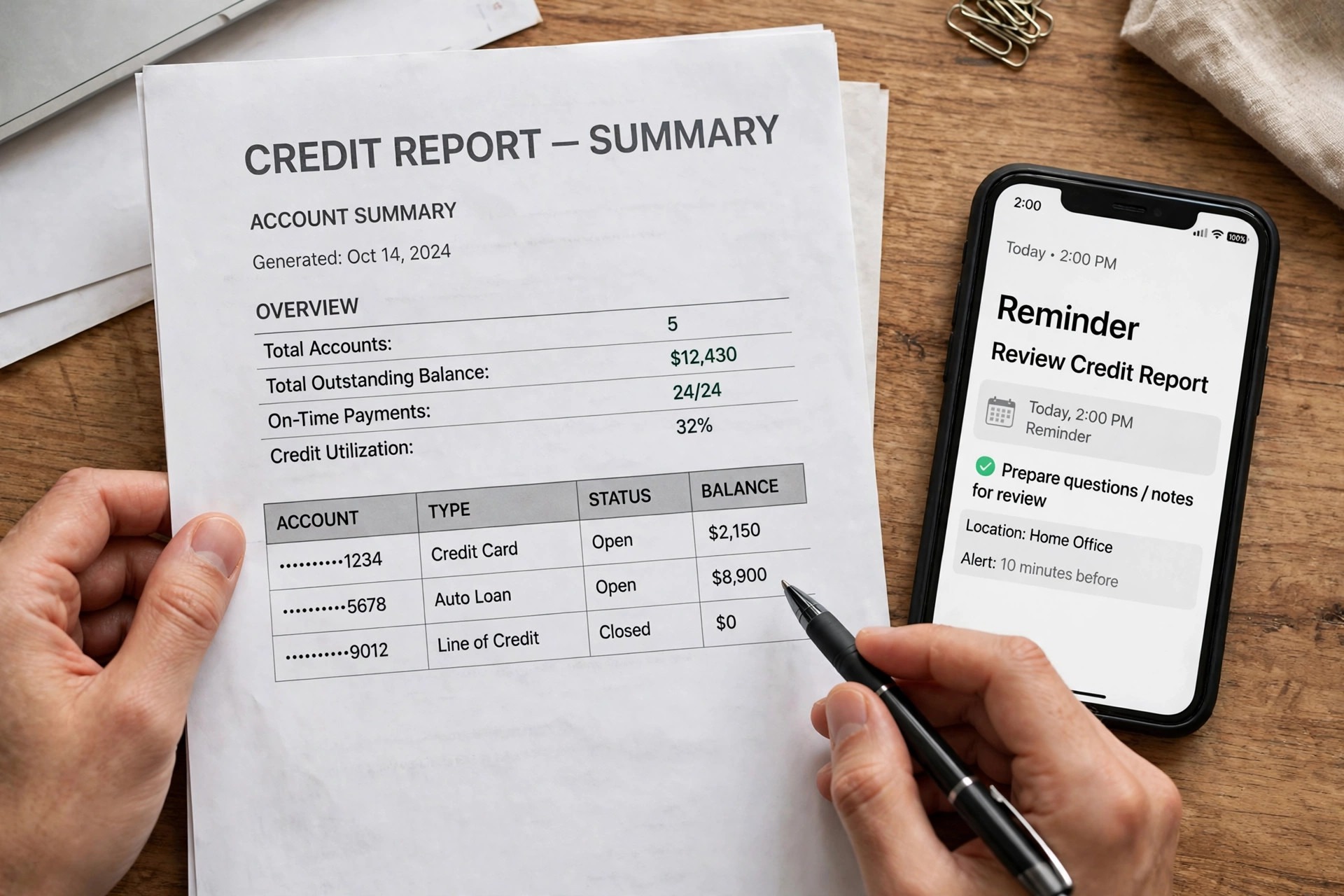
Step 1. Pull all three reports. Go to AnnualCreditReport.com, the only website authorized by federal law for free reports from Equifax, Experian, and TransUnion. The FTC confirms you can now get a free report from each bureau every week through that site. Read all three, not just one, because an error can sit on one report and not the others. Check names, addresses, accounts, balances, payment history, and anything you do not recognize.
Step 2. Dispute errors, with both sides. If something is wrong or does not belong to you, you have the right to dispute it, and disputing is free. Dispute with the bureau that shows the error and with the company that furnished the information. Include what is wrong, the account involved, and copies of documents that support you. Keep copies of everything you send, and send copies, never originals. Bureaus generally have 30 days to investigate, sometimes up to 45 days in defined circumstances, and if the information cannot be verified, it must be corrected or removed. The CFPB publishes step-by-step dispute guidance and sample letters, and you can file a complaint with the CFPB if a dispute is not handled properly.
Step 3. Bring utilization down. Pay balances down, pay more than the minimum where you can, and consider paying before the statement closing date, because the balance reported to the bureaus is usually the statement balance. The goal most experts point to is staying under 30 percent of your limits, and lower is better. You do not need to carry a balance and pay interest to build credit. Paying in full does the job without the interest cost.
Step 4. Build an on-time system, not just good intentions. Set up autopay for at least the minimum on every account, add calendar reminders a few days before each due date, and line due dates up with paydays where an issuer lets you change them. If you have fallen behind, the CFPB guidance is simple: get current and stay current. One clean year of on-time payments will not erase the past, but it changes what the most recent record says about you, and recent history carries real weight.
Step 5. Add the right builder tools, carefully. If you have little or no credit, or you are rebuilding, two products come up in CFPB guidance for a reason. A secured credit card requires a cash deposit, and that deposit usually sets your credit limit. You use it like a regular card, you get a bill, and you pay it. Before you apply, ask about the deposit, the fees, the interest rate, whether the issuer reports to all three bureaus, and how and when you can graduate to an unsecured card and get the deposit back. A credit-builder loan works in reverse: the lender holds the loan amount in a savings account while you make monthly payments, the payments are reported, and you receive the money at the end. Ask for the total cost, the payment schedule, and which bureaus receive the reporting. Only take on either product if the payment fits the budget you actually have. A builder product you fall behind on hurts more than it helps.
Step 6. Use authorized-user status with clear rules. Being added as an authorized user means you get a card on someone else’s account. You are not legally responsible for the debt. The primary cardholder is. It can help your file only if the issuer reports authorized-user accounts to the bureaus, so confirm that with the issuer first. Experian makes the other condition plain: it helps when the primary cardholder has strong habits, a long on-time record, and a low balance. It can hurt when that person pays late or runs the balance up, because that history can land on your report too. Only do this with someone you trust, on an account in good standing, with a clear agreement about whether you will even use the card. Never pay a stranger for authorized-user access.
FROM GOOD CREDIT TO FUNDING POWER

This is the part the voices in this space, from Ross Mac breaking money down in plain language to Earn Your Leisure talking about assets over liabilities, keep coming back to. Credit is not the goal. What credit lets you do is the goal.
For a young business, personal and business credit are not fully separate, no matter how the paperwork looks. Many small business lenders review the owner’s personal credit as a primary factor, especially for a newer business with a thin file of its own. With SBA loans, the structure makes it explicit: any owner with 20 percent or more of the business must personally guarantee the loan, which means the lender is looking at that owner personally. The SBA itself does not set one universal minimum credit score. Individual lenders set their own standards, and stronger personal credit generally means more options and better terms, while weaker credit narrows the field before anyone has looked at your business plan.
So the sequence in this post is business strategy, not just personal housekeeping. Clean reports mean fewer surprises in underwriting. Lower utilization means you are not applying from a position that already looks stretched. A long, on-time record means the file tells a consistent story. From there, build the business side on its own track as well: keep business finances separate, pay business obligations on time, and let the business develop its own credit history over time. None of that guarantees an approval. Revenue, cash flow, time in business, and collateral all matter, and every lender weighs them differently. What good personal credit does is remove one of the most common reasons a good business gets told no early, or gets offered terms that are hard to grow on.
Think of it the way this lane will keep framing it. A score is a record of trust. Funding power is what that trust can be converted into, carefully, for equipment, for a space, for working capital that lets a real opportunity get finished instead of just talked about.
THE LONG GAME
Start this week with the free part. Pull the three reports. Mark every error. Set autopay on every account you have. Pick one balance and start bringing its utilization down. That is the whole foundation, and it costs nothing but attention. Then give it time to compound, because in credit, boring and consistent beats dramatic and occasional, every single time.
Featured image: Generated for The Green Social
Educational Disclaimer: Content about investing, credit, retirement, annuities, and personal finance on The Green Social is for general education and information only. It is not financial, investment, tax, or legal advice, and it is not a recommendation to buy, sell, or hold any product or security. Everyone’s situation is different; speak with a licensed financial, tax, or legal professional about your own circumstances before making a decision.
Editorial & Reporting Disclaimer
The Green Social is an independent media and commentary publication, not a wire service or a court of record. News and media posts are based on publicly available information and reporting by the sources named in the post at the time of publication. Facts that could not be independently verified are identified as reported or unverified, or are omitted. Quotations are attributed to their stated sources; a quotation’s inclusion means it was reported, not that The Green Social endorses it.
Analysis and opinion in this post are the author’s own and are labelled as such; they are not statements of fact. Events, statements, and coverage may develop after publication — material updates and corrections will be noted on this post.
If you are a person or organisation discussed in this post and believe any statement is inaccurate or incomplete, or you wish to provide a response for publication, contact us through the Contact page on thegreensocial.com. Verified corrections and substantive responses are added promptly. Nothing in this post is legal, financial, or professional advice.
#FinancialLiteracy #CreditRepair #FinancialFreedom




Leave a Reply
Want to join the discussion?Feel free to contribute!