
Nasdaq Falls Into a Correction as Chip Stocks Slide Before Nvidia Earnings
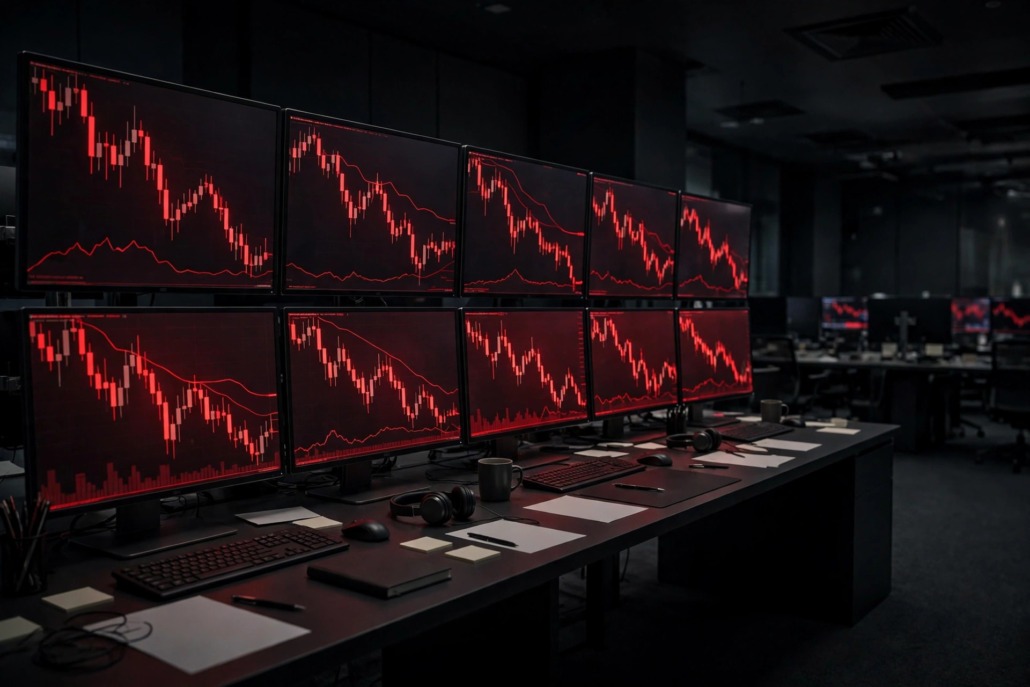
Wall Street had its roughest day of the month on Monday, and the damage was centered on the trade that has carried the market all year. The Nasdaq Composite fell 2.49 percent to 24,509.76, the S&P 500 fell 1.92 percent to 7,416.59, and the Dow Jones Industrial Average fell 739.38 points, or 1.41 percent, to 51,608.17, according to closing figures reported by Reuters, the Associated Press and Yahoo Finance. It was the third straight loss for both the S&P 500 and the Nasdaq, and Monday’s close left the Nasdaq more than 10 percent below its record close of October 6, which puts the index in a correction, Reuters reported.
WHAT HAPPENED IN THE CHIP SELLOFF
Chip stocks took the hardest hit. The Philadelphia Semiconductor Index fell 5.3 percent on Monday, Reuters reported. Nvidia fell 4.12 percent to $156.14, Advanced Micro Devices fell 5.58 percent, and Micron fell more than 7 percent. Nvidia is the largest name in the AI buildout, so when it slides a day before it reports earnings, the selling rarely stops with one stock. Data center, memory and chip equipment names followed it down, and the selling spread into the broader technology sector.
Image: Generated for The Green Social
THREE THINGS HIT AT ONCE
The first was leadership. Jensen Huang resigned as Nvidia’s president, chief executive and a director on November 12, and finance chief Colette Kress is running the company on an interim basis. On Monday, Reuters reported that Nvidia’s board is not considering bringing Huang back, despite a petition calling for his return that has passed 180,200 signatures and public support from Elon Musk and President Donald Trump. A source told CNBC the board is not discussing a return. That leaves the leadership question open heading into the company’s first earnings report since the change.
The second was policy. The Commerce Department’s Bureau of Industry and Security filed an interim final rule on Monday, called Addressing Remote Access to Advanced Semiconductors. Under the rule, a license will be required to ship advanced AI chips to Singapore, Malaysia, Indonesia, Thailand and Brazil, and to any data center that gives companies from China and other embargoed countries large scale remote access to those chips, above a threshold of 12 million aggregate TPP, a measure of computing power. The rule is scheduled to take effect when it is published in the Federal Register on November 19, existing operators will have 90 days to get licensed, and it formally rescinds the 2025 AI Diffusion Rule, according to the bureau’s filing as reported by TechCrunch and Reuters. In plain terms, Washington is closing a route that let restricted companies rent American computing power from data centers in other countries instead of buying the chips directly.
The third was a colder forecast for the AI buildout itself, plus the same rate pressure that has hung over stocks since October’s inflation report. A weekend research note from SemiAnalysis cut its forecasts for AI accelerator spending, lowering its 2028 estimate by 28 percent to $758 billion and its 2030 estimate by 40 percent to $923 billion. At the Federal Reserve, officials sounded split on pace this week. Cleveland Fed President Beth Hammack told Bloomberg Television on Monday that she sees mounting inflation pressures but prefers moving in smaller increments, Reuters reported. St. Louis Fed President Alberto Musalem said on Tuesday that the economy will likely require several interest rate increases before the spring of 2027 to return inflation to the Fed’s 2 percent target, and that the current policy rate, in the 3.75 to 4.00 percent range, is as much as a percentage point below where it needs to be, Reuters reported. Musalem is not a voter on rate policy this year. The Fed next meets December 8 to 9 and is expected to approve a quarter point hike.
WHY IT MATTERS
A correction is a fall of 10 percent or more from a recent high. It is a label for how far an index has dropped, not a prediction of what happens next, and corrections are a normal part of how markets move, even in strong years. What makes this one worth watching is concentration. So much of the market’s gain this year ran through a small group of AI and chip stocks that a leadership story at one company, a new export rule and a lower spending forecast could move the whole Nasdaq in a single session. Tuesday night is the next test. Nvidia reports its fiscal third quarter results after the close, at about 4:20 PM ET, with its earnings call at 5:00 PM ET. The company guided revenue to $108.0 billion, plus or minus 2 percent, and analysts expect about $109 billion in revenue and $2.47 in adjusted earnings per share, according to Reuters and Yahoo Finance. The outlook the interim leadership gives may matter as much as the quarter itself.
WHAT IT MEANS FOR EVERYDAY MONEY
Start with the account most people actually see move. A market drop like Monday’s shows up first in retirement and brokerage balances, because the big index funds many 401(k) plans hold own the same large technology names that led the fall. A lower balance on a statement is a paper change until money is sold or moved, and one session, even a rough one, does not change what a long term account is built to do. This post is not a buy or sell call, and a correction headline on its own is not a reason to make one.
The consumer picture, meanwhile, did not crack on Tuesday morning. The Census Bureau reported that retail sales rose 0.2 percent in October to $748.2 billion, after a 0.8 percent gain in September, matching the forecast in a Reuters poll. Under the headline, core retail sales, which strip out autos, gasoline, building materials and food services, rose 0.6 percent, as households pulled back on motor vehicles and other big ticket goods but kept spending elsewhere, Reuters reported. Sales were up 6.8 percent from a year earlier. For a small business heading into the holiday season, that mix matters more than the stock chart: shoppers are still spending, but they are choosier on the biggest purchases, the ones most sensitive to financing costs.

Photo: Mikhail Nilov / Pexels
Credit and savings are where the Fed side of this story lands at home. If the Fed raises rates again in December, as markets expect, variable rate credit card and home equity line APRs stay high into the new year, and a balance carried month to month keeps costing more to hold. The other side of the same policy is what savers earn. Higher for longer rates are why high yield savings accounts and CDs still pay what they pay, and knowing which rate you pay and which rate you earn is the basic homework. That difference, APR versus APY, is exactly what Suze Orman walked through in her November 8 Suze School episode on how interest rates work, alongside her updated guidance on I Bonds. We will follow Nvidia’s results and the December Fed decision in our Money & Ownership coverage on thegreensocial.com.
Featured image: Image: Generated for The Green Social
Editorial & Reporting Disclaimer
The Green Social is an independent media and commentary publication, not a wire service or a court of record. News and media posts are based on publicly available information and reporting by the sources named in the post at the time of publication. Facts that could not be independently verified are identified as reported or unverified, or are omitted. Quotations are attributed to their stated sources; a quotation’s inclusion means it was reported, not that The Green Social endorses it.
Analysis and opinion in this post are the author’s own and are labelled as such; they are not statements of fact. Events, statements, and coverage may develop after publication — material updates and corrections will be noted on this post.
If you are a person or organisation discussed in this post and believe any statement is inaccurate or incomplete, or you wish to provide a response for publication, contact us through the Contact page on thegreensocial.com. Verified corrections and substantive responses are added promptly. Nothing in this post is legal, financial, or professional advice.
Educational Disclaimer
Educational Disclaimer: Content about investing, credit, retirement, annuities, and personal finance on The Green Social is for general education and information only. It is not financial, investment, tax, or legal advice, and it is not a recommendation to buy, sell, or hold any product or security. Everyone’s situation is different; speak with a licensed financial, tax, or legal professional about your own circumstances before making a decision.
#Nasdaq #StockMarket #Nvidia






Leave a Reply
Want to join the discussion?Feel free to contribute!